Can’t play the video? Watch here.
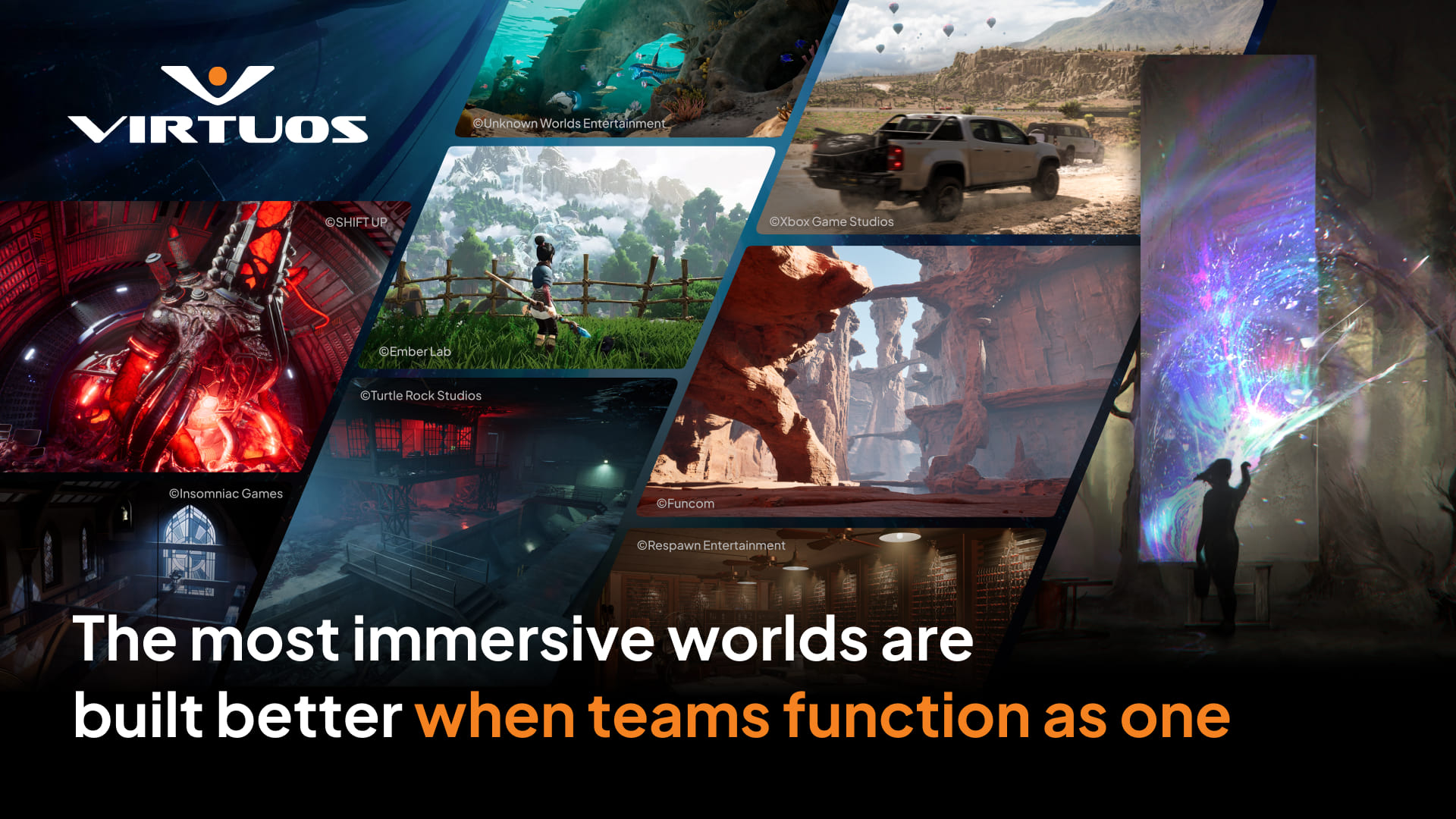
In the fifth episode of The Virtuos Co-Dev Blueprint podcast series, we dive into environment art, a highly visible yet technically demanding discipline that serves as the foundation for modern game immersion. As digital worlds expand exponentially and production timelines tighten, managing asset scale has shifted from a simple content pipeline into a core, strategic art form.
To unpack how modern environment art collaborations protect and amplify a developer’s creative vision, we brought together a global panel of art leads from across Virtuos’ studios: Gan Songlin (Art Director, Virtuos Chengdu), Kristian Pedlow (Senior Art Director, Sparx* – A Virtuos Studio), Do Thi Thu Hang (Art Production Manager (Environment), Glass Egg – A Virtuos Studio) and Javier Alaiz (Lead Environment Artist, Black Shamrock – A Virtuos Studio).
Key Takeaways:
- Environment art is the core connective tissue of world-building: Modern landscapes have evolved from passive, static background painting into complex, tech-heavy “storytelling spaces” that actively dictate character pacing and environmental narrative.
- The Three Tiers of Engagement offer structured modularity: Successful environment co-development relies on scaling across clear integration frameworks, from Tier 1 high-volume prop generation to Tier 2 modular prefab systems and Tier 3 total level ownership.
- The unyielding reality of Art vs. Design metrics: Visual beauty must bend to functional gameplay boundaries. Environmental scatter and assets must strictly align with design grid parameters, character animation paths, and functional combat cover heights right from day one.
- Advanced engine features are reshaping the technical pipeline: The transition to state-of-the-art engine pipelines like Unreal Engine 5 fundamentally alters how massive environments are optimized, utilizing features like Nanite geometry and Lumen dynamic illumination as standard artistic tools.
Episode Chapters:
Introduction & Guest Backgrounds (00:00 – 05:44)
The panel opens with our guest leads sharing their professional backgrounds and studio histories. Spanning decades of collective game industry experience, the panel introduces their unique regional perspectives and highlight their studios’ recent structural contributions to global premier AAA properties.
Defining the Discipline: What is Modern Environment Art? (05:44 – 09:36)
The artists discard the traditional definition of environment art as mere “background scenery”. Instead, they explore the technical reality of the discipline today: building living, believable worlds where engine logic, player lighting, and level assets seamlessly merge to construct functional storytelling architecture.
Tier 1 Focus: Managing High-Volume Asset & Prop Production (09:36 – 15:27)
Focusing on foundational execution, the panel references massive real-world biomes from high-profile productions like Forza Horizon 6 and Mafia: The Old Country. They detail the massive structural challenges of managing vast texture libraries, establishing strict quality benchmarks for automated mass production, and maintaining unwavering visual consistency across thousands of distinct prop variants.
Tier 2 Focus: The “Lego” Philosophy of Modular Kit Building (15:27 – 23:25)
The group breaks down the methodology behind modular prefab kits, using their studio work on blockbuster properties like Marvel’s Spider-Man 2 as a guide. They emphasize the crucial need for early-stage integration between artists and designers to align visual scaling with strict gameplay parameters, ensuring doorways accommodate character animation rigs and cover layouts match predictable boundary metrics before a grid is locked.
Realizing Tier 3: End-to-End Level Art Ownership (23:25 – 30:34)
Moving to full map responsibility on titles like Call of Duty: Black Ops 6, the discussion highlights the “Ready-to-Ship” mindset required for total level ownership. The art leaders share their strategies for mapping out a client’s design language, building deep creative trust, and successfully taking a level straight from an initial greybox state to final world dressing, technical optimization, and engine optimization.
Overcoming Engine Friction Points, Training, & Tech Restrictions (30:34 – 34:54)
The panel addresses the practical friction points that naturally occur inside co-development environments. They share candid solutions for navigating security lockdowns on sensitive IP, mastering client-specific proprietary engine variations, and mitigating creative drift through strategic on-site training sessions directly inside client studios.
Lightning Round: Games That Set New Benchmarks (34:54 – 40:54)
To close out the episode, the guests participate in a fast-paced roundtable to share external projects that inspire them. From hyper-realistic worlds to stylized triumphs, each artist spotlights a game from the last two years that they believe represents the current absolute peak of immersive environmental storytelling.
Want to learn more about how collaborative environment art partnerships can scale your game world and protect your creative vision? Reach out to our team today.